Inferno
Inferno: Mapping Justice in a Fallen World
layout: book-review title: Inferno author: Dante Alighieri cover: assets/img/book_covers/Inferno.jpg categories: classics historical-fiction novels tags: dante, divine-comedy, medieval-literature, theology, epic-poetry buy_link: https://www.penguin.co.uk/books/62039/the-divine-comedy-by-dante-alighieri-trans-with-comm-mark-musa-intro-and-notes-mark-musa/9780142437223 released: 1320 stars: 5 status: Finished
Inferno
Dante’s Inferno is often approached as a book one already knows. Its images circulate freely in the cultural imagination: circles of Hell, rivers of fire, sinners frozen in ice, Satan chewing on traitors. Yet this familiarity is misleading. The poem itself is far more exacting, more morally unsettling, and more intellectually demanding than its afterlife suggests. What confronts the reader is not a medieval fantasy of punishment, but a sustained attempt to understand how human lives acquire shape, direction, and ultimately finality.
The opening image of the dark wood is not symbolic in any loose or decorative sense. It is precise. Dante begins the poem not at the moment of sin, nor at the moment of judgement, but at the moment when clarity has already been lost. The pilgrim does not know how he arrived there. That ignorance is essential. Hell, as the poem will reveal, is rarely the result of a single decision. It is the accumulation of choices made without sufficient attention, justified at the time, later impossible to reverse. The wood is dark because the pilgrim has ceased to see properly.
What follows is a descent that is at once physical, moral, and intellectual. Hell in Inferno is not chaotic. On the contrary, it is ordered with an almost obsessive precision. Each region has its place, each punishment its logic, each soul its history. The effect is deeply unsettling, because the poem refuses the consoling idea that evil is random or inexplicable. Dante insists that moral failure has a structure, and that this structure can be known.
The punishments that have made the poem famous are not acts of imaginative cruelty. They are arguments. When the soothsayers walk with their heads twisted backwards, when the sowers of discord are split open, when traitors are frozen in ice, the reader is not being invited to enjoy the spectacle. These punishments expose the inner form of the sin itself. What the sinner chose inwardly becomes visible outwardly. Hell is a place where nothing is hidden, and nothing can be reframed through self-justification.
One of the most disturbing aspects of Inferno is how often the damned appear recognisable, even persuasive. Francesca da Rimini speaks in the language of love poetry; Brunetto Latini addresses Dante with affection and pride; Farinata stands with aristocratic dignity amid the flames. Dante allows these figures their voices. He listens to them carefully. He records their words with extraordinary attentiveness. Yet listening is not the same as absolving. Again and again, the poem demonstrates how eloquence, loyalty, or suffering can coexist with moral blindness.
The pilgrim himself struggles to understand this. He weeps, hesitates, feels pity where he should not. At one point he faints. These responses are not mistakes on Dante’s part. They are essential to the poem’s movement. Inferno is not a static vision of damnation; it is a process of education. The pilgrim must learn that compassion detached from judgement can become another form of error. The poem never celebrates cruelty, but it does insist that justice cannot be reduced to sentiment.
Virgil’s presence is crucial here. As guide, he represents a disciplined intelligence, shaped by classical thought and governed by measure. He explains, restrains, corrects. He does not shout or threaten; his authority is quiet and assumed. Yet he, too, has limits. There are moments when his confidence falters, when he must wait, when he cannot proceed without help. These moments are among the most telling in the poem. Dante does not diminish reason; he shows what reason can and cannot do.
Language is one of the ways in which the poem refuses distance. Dante’s choice to write in the vernacular was not an act of accessibility in the modern sense; it was a declaration that moral knowledge belongs to lived experience. The poem moves effortlessly between registers. It can be obscene, lyrical, philosophical, brutal, tender. Nothing is excluded. Hell is populated by citizens, not abstractions, and Dante’s language ensures that they remain so.
Florence is never far away. The poem is filled with contemporary figures, political disputes, personal betrayals. Dante’s exile sharpens his judgement, but it does not distort it into mere resentment. Friends and enemies are treated with the same severity. What matters is not allegiance but responsibility. The poem’s anger, when it appears, is never careless. It is the anger of someone who believes that public life matters, and that its corruption has eternal consequences.
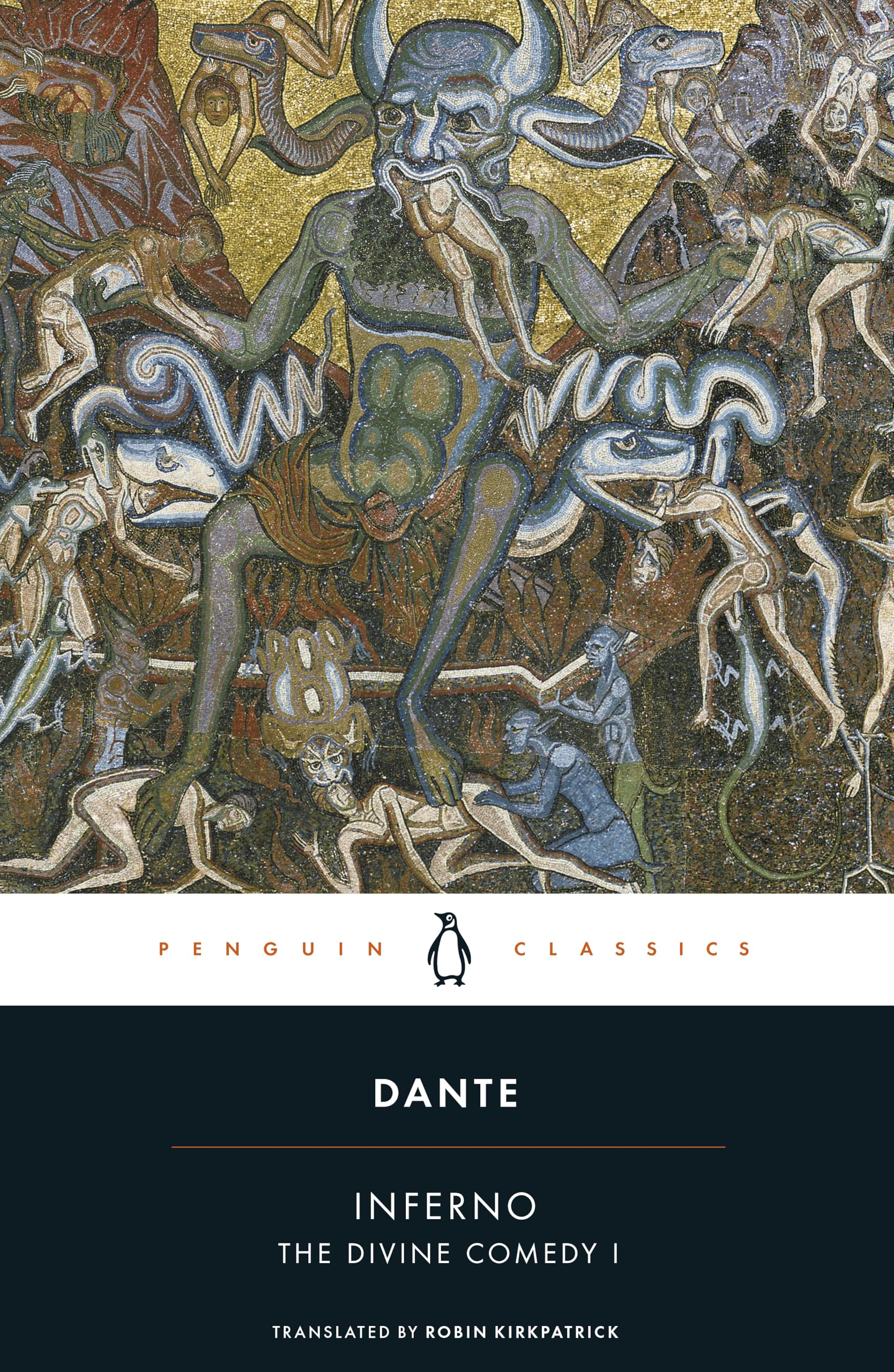
The deeper the descent, the quieter the poem becomes. Noise, chaos, and movement give way to silence, ice, and immobility. At the very bottom of Hell, Satan is not a figure of theatrical power. He is trapped, mindless, chewing endlessly on the traitors he shares his prison with. This is one of Dante’s most radical gestures. Evil, at its furthest extreme, is not energetic or creative. It is sterile, repetitive, frozen.
The final image of Inferno is deliberately understated. After all the suffering, the pilgrim climbs upward and sees the stars again. There is no celebration, no release of tension. The journey through Hell has been necessary, but it is not the destination. What has changed is not the world, but the pilgrim’s capacity to see it.
To read Inferno attentively is to be reminded that moral clarity is hard won, that self-deception is subtle, and that responsibility cannot be deferred indefinitely. The poem’s middle regions are where Dante’s vision becomes most unsettling, precisely because they resist easy moral distancing. As the pilgrim moves beyond the sins of incontinence — lust, gluttony, avarice, wrath — the atmosphere of Hell changes. The earlier circles are noisy, turbulent, filled with motion and complaint. The damned are swept, battered, submerged, or locked in futile struggle. These punishments feel almost kinetic, as though the sins themselves have not yet exhausted their energy. Desire still burns, anger still boils, appetite still strains against its limits.
Yet even here, Dante resists caricature. The lustful are not condemned for loving too much but for loving without order. Their punishment — being carried endlessly by a violent wind — gives physical form to a life governed by impulse rather than judgement. What they suffer is not fire or torture but the absence of rest. Desire, once freed from responsibility, becomes incapable of stillness.
As the descent continues, the poem grows darker in a more literal sense. Violence occupies the centre of Hell, divided with chilling clarity into violence against others, against oneself, and against God or nature. This tripartite division is not decorative. Dante is thinking carefully about what violence is and where it originates. To harm another is one thing; to destroy oneself is another; to deny the order of creation itself is the deepest violence of all.
The wood of the suicides remains one of the most disturbing passages in the poem. Here the language slows, thickens. Souls who rejected their bodies are denied them, transformed into gnarled trees, bleeding when broken. The horror of the scene lies not in spectacle but in implication. These souls sought escape from suffering through self-annihilation; instead, they are fixed in a form that denies both agency and speech. Only when wounded can they speak, and even then their words emerge as blood. Dante does not moralise overtly here. He allows the punishment to speak for itself.
Pier della Vigna’s speech, measured and dignified, complicates any easy judgement. His insistence on loyalty and honour is persuasive. Yet once again, Dante draws attention to the gap between narrative self-presentation and moral truth. Pier’s tragedy is real, but his refusal to endure suffering without asserting control over its end remains the defining fact of his damnation. The poem neither mocks nor sentimentalises him. It leaves the reader in an uneasy space, forced to acknowledge both his suffering and his responsibility.
Fraud, which occupies the lower regions of Hell, is where Dante’s moral imagination sharpens into something almost forensic. Fraud is not driven by passion or impulse but by calculation. It requires intelligence, foresight, and an understanding of trust — all of which are turned against others. For Dante, this makes fraud uniquely destructive. It corrodes the social fabric itself.
The Malebolge, with its ten ditches of fraudsters, is one of the poem’s most varied and unsettling landscapes. Here Dante’s tone shifts repeatedly: satirical, grotesque, cruelly humorous, suddenly grave. Barrators immersed in boiling pitch; hypocrites crushed beneath the weight of gilded cloaks; thieves merging grotesquely with serpents; false counsellors wrapped in tongues of flame. Each punishment feels inventively precise, yet never arbitrary.
What unites these sinners is not merely deceit, but the misuse of intelligence. These are people who understood how others think, feel, and trust — and exploited that knowledge. Dante’s anger is more visible here, though it remains controlled. He has little patience for cleverness divorced from responsibility. The poem suggests, again and again, that intelligence without ethical orientation is among the most dangerous human capacities.
One of the most striking figures in this region is Ulysses, Dante’s reimagined Odysseus. Unlike the Homeric hero driven by fate and longing for home, Dante’s Ulysses is consumed by curiosity itself. His final voyage is undertaken not out of necessity but desire — a desire to know without limit. His speech is among the most rhetorically powerful in the poem, filled with appeals to dignity, reason, and human potential. It is easy to admire him. That is precisely the danger.
Ulysses’ ship sinks not because knowledge is forbidden, but because knowledge pursued without humility becomes self-destructive. Dante does not condemn inquiry; he condemns inquiry that refuses any boundary. In this sense, Ulysses becomes a mirror for the reader. The poem quietly asks whether admiration for intelligence can blind us to the costs of its misuse.
As Hell deepens, movement slows. The air grows colder. Sound diminishes. Where earlier circles were filled with cries and motion, the lower regions are marked by stillness. This progression is deliberate. Sin, for Dante, does not culminate in chaos but in paralysis. The final sin is not excess but negation.
Treachery, punished in the frozen lake of Cocytus, represents the complete breakdown of trust. Here, language itself begins to fail. Some souls cannot speak; others can only chatter through chattering teeth. Tears freeze in their eye sockets. The punishments are severe, but what strikes most forcefully is their silence. These are people who severed the bonds that made communal life possible. Their punishment is isolation in its purest form.
Ugolino’s story, told amid this frozen stillness, is one of the most harrowing narratives in literature. Dante recounts it without embellishment, allowing the horror to emerge through restraint. The starvation of Ugolino and his children, the gradual realisation of their fate, the ambiguity of what ultimately occurs — all of this is presented with a calm that makes it almost unbearable. Dante does not interrupt with commentary. He trusts the reader to respond.
At the very bottom of Hell stands Satan, and here Dante makes his most radical imaginative choice. Satan is not a master of Hell. He does not command, tempt, or speak. He is immobilised, half-buried in ice, beating his wings in a futile effort that only deepens his imprisonment. Each flap generates the freezing wind that traps him further. Evil, in its purest form, is self-defeating.
This vision dismantles any lingering romanticism about rebellion. Satan’s sin was not ambition in the heroic sense, but refusal — refusal to accept dependence, limitation, and order. His punishment is not fire but ice, not suffering imposed from without but a condition generated from within. The traitors he chews are not enemies but mirrors.
The transition out of Hell is famously strange. Dante and Virgil do not walk out; they climb, passing the centre of the earth, reversing orientation without noticing it. What was down becomes up. The shift is disorienting, and deliberately so. Moral perspective, Dante suggests, cannot be taken for granted. It must be learned, often painfully.
When the pilgrim finally emerges and sees the stars again, the moment is understated. There is relief, but no triumph. Hell has not been overcome; it has been understood. The journey has stripped away illusion rather than delivering consolation. That restraint is part of the poem’s integrity.
What Inferno offers, ultimately, is not a system of punishments but a way of seeing. It insists that actions have shape, that choices accumulate, that self-justification is one of the most dangerous habits of mind. It refuses the comforting belief that evil belongs only to others, or that intelligence, suffering, or sincerity automatically absolve.
This is why the poem continues to unsettle. It does not flatter modern sensibilities, nor does it rely on medieval authority. It speaks in a voice that assumes moral seriousness as a human responsibility rather than a theological abstraction. Its vision of justice is severe, but it is also coherent, and coherence, once seen, is difficult to ignore.
To read Inferno well is to accept discomfort without defensiveness. It is to recognise how easily eloquence can excuse, how quickly loyalty can curdle into blindness, how often freedom is mistaken for the absence of limits. Dante does not offer redemption here; that belongs to the later cantiche. What he offers instead is clarity. And clarity, in this poem, is never painless.